
WiZink and Dia Credit Cards: Impact and Savings 2026
The Impact of the New Financial Agreement on Your Daily Economy
The financial market and the retail sector have just crossed paths in a way that promises to transform how millions of consumers manage their monthly budgets. When specialized entities like WiZink close strategic alliances with food giants like Dia, the direct consequences are immediately felt in families' pockets. This type of commercial movement seeks to attract new customers by promising exclusive advantages, but behind every marketing campaign lies a complex structure of costs and fees that every responsible consumer must analyze closely before signing any contract.
Analyzing this type of agreement in depth requires going beyond optimistic headlines announcing big savings or welcome gifts. Economic reality shows that using credit cards associated with retail brands can become a double-edged sword. On one hand, they offer payment facilities and occasional rewards on the shopping basket, a significant relief in times of persistent inflation. On the other hand, the temptation of installment debt and the interest rates associated with certain financing models can completely destabilize personal finances that are already tight. Throughout this article, we will break down the ins and outs of this alliance and give you the keys to protect your money.
To understand the true scope of this commercial union, it is necessary to observe current consumer behavior. With a shopping basket that absorbs an increasingly larger share of monthly income, any formula that promises direct discounts is highly attractive. However, the fine print of financial contracts usually harbors crucial details about maintenance fees, late payment costs, and payment conditions that can transform supposed savings into an unexpected expense. Far from offering magical solutions, the objective of this analysis is to provide you with the analytical tools necessary to discern when a credit card represents a real saving opportunity and when it constitutes an unnecessary risk to your wealth.
How Credit Cards Linked to Major Retailers Work
Credit cards issued in collaboration with supermarket chains operate under a very aggressive loyalty model. The main hook consists of offering cash back or direct percentage discounts on each purchase ticket made at the chain's establishments. At first glance, accumulating a three or five percent reward on food products seems like an excellent idea to reduce fixed household expenses. However, the profitability of these financial products depends almost entirely on the cardholder's payment behavior, fundamentally dividing those who clear their full balance at the end of the month from those who choose to defer payments.
The real business for issuing entities lies in revolving financing, a system through which the customer pays a fixed monthly fee while the rest of the outstanding debt generates interest at a fairly high rate. This mechanism, although convenient for dealing with extraordinary expenses, can turn a small purchase into a long-term debt due to the cumulative effect of compound interest. For this reason, personal finance experts insist on the need to configure the card so that payment is made in full each month, thus avoiding falling into the trap of disproportionate interest rates that silently erode the household's saving capacity.
In addition to interest on deferred payments, it is vital to examine the collateral costs associated with the daily operation of these cards. Many of these cards include optional payment protection or accident insurance that is activated almost imperceptibly during the sign-up process, increasing the monthly bill. Likewise, withdrawing cash from ATMs with credit cards usually carries much higher fees than a conventional debit card. Knowing these technical conditions allows you to use the service intelligently, maximizing the commercial advantages of the supermarket without assuming unnecessary financial risks in the process.
Comparison of Costs and Benefits in Supermarket Cards
To clearly visualize what these payment tools represent compared to other options on the market, it is highly useful to analyze a comparison table based on the average conditions usually offered by specialized financial entities in collaboration with the retail sector.
| Usage Method | Main Advantages | Risks and Hidden Costs | Impact on Savings |
|---|---|---|---|
| Full payment at the end of the month | Zero interest, direct discounts on purchases, no standard issuance fees. | Possibility of spending more than budgeted due to ease of use. | Very positive if budget discipline is maintained. |
| Revolving deferred payment | Reduced monthly installments, flexibility for specific unexpected economic events. | Very high APR interest rates that can exceed 20%, chronic debt. | Negative in the medium and long term due to the cost of interest. |
| Cash withdrawal | Immediate liquidity at ATMs worldwide for urgent emergencies. | Very high withdrawal fees and immediate application of credit interest rates. | Highly detrimental to the user's financial health. |
The table above clearly reflects that user behavior completely determines the final balance of the operation. While a disciplined consumer who uses the card exclusively to benefit from supermarket discounts and pays the full accumulated balance at the end of the month obtains an obvious net benefit, one who uses deferred financing experiences a severe deterioration of their economic resources. Retail brands and financial entities design these products by statistically calculating the percentage of customers who will fall into the temptation of deferring payments, making the interest generated by this segment a primary source of income.
Therefore, when evaluating the convenience of applying for a card resulting from agreements like the one between WiZink and Dia, the user must perform a self-assessment exercise regarding their own spending discipline. If there is a habit of spending beyond actual income capabilities, adding a new credit instrument to the wallet will only increase the likelihood of over-indebtedness. If, on the other hand, there is a strictly controlled family budget and the card is used merely as a substitute for cash to shave off a few euros in rewards on the weekly grocery run, the decision can be financially neutral or slightly favorable.

What the Video Explains
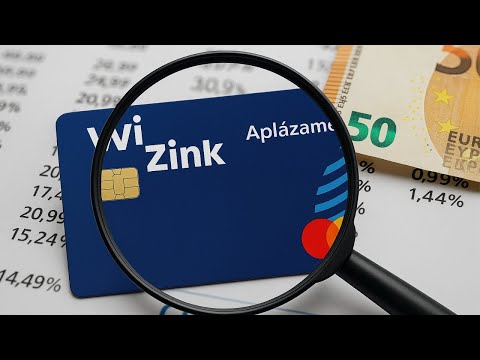
In this video (WiZink Aplázame Card: the truth nobody tells you before applying for it), the essentials of the topic are explained visually. In summary: Are you thinking about applying for the WiZink Aplázame Card? In this video, I explain how this card really works, what......
Common Mistakes When Using Credit Cards at Retail Outlets
One of the most frequent mistakes consumers make when accepting credit cards offered at checkout lines or through promotional campaigns is failing to read the fine print of the contract. Often, the conditions of the initial promotion, such as a substantial discount on the first purchase or a high temporary reward, mask less favorable contractual conditions starting from the sixth month or the first year of validity. Failing to review current fee schedules and unilateral changes in interest rates that the issuing entity can apply with prior notice is a negligence that usually costs the cardholder dearly.
Another common slip-up is confusing the minimum monthly payment with the actual amortization of the debt. When receiving the bank statement and seeing that the payment due is small, people tend to think the debt is under control, ignoring that most of that amount goes toward covering interest and fees, while the principal of the debt is barely reduced. This phenomenon extends the repayment term for years, exponentially multiplying the total cost of the goods initially purchased at the supermarket. Basic financial education teaches that the lower the monthly payment in a revolving credit setup, the higher the total financial cost eventually paid.
Finally, a mistake that seriously affects financial health is centralizing all daily payments on a single credit card without rigorous tracking. Mixing everyday food expenses with extraordinary purchases of technology or trips financed in installments makes calculating actual monthly spending extremely difficult. Experts recommend separating payment methods: using a debit card for daily expenses and reserving credit solely for exceptional, properly planned situations, thus avoiding unpleasant surprises when checking the available balance at the end of the month.
Effective Strategies to Maximize Savings Without Risks
Taking advantage of the benefits of alliances between banking and retail without endangering economic stability requires applying a series of strict self-control rules. The first golden rule is to automate the full settlement of the credit card balance so that it is charged entirely to the main checking account on the first business day of each month. In this way, you enjoy all the rewards, discounts, and points accumulated at the supermarket without paying a single cent in interest or financial costs derived from deferred payments.
Another fundamental strategy is to allocate the savings obtained through these cards to an emergency fund or a high-yield savings account, instead of using them to increase current consumption. If, thanks to supermarket rewards, we manage to save a fixed amount over the year, reinvesting that difference into reducing higher-cost debts or building a financial cushion provides much-needed solidity against possible macroeconomic setbacks. Discipline in managing credit cards is the differentiating factor that separates those who use the financial system to their advantage from those who end up trapped in debt spirals.
Likewise, it is advisable to perform periodic reviews of bank statements and constantly compare existing offers on the market. The financial sector is highly dynamic, and what represents an attractive competitive advantage today may become obsolete in a few months compared to new proposals from other entities. Maintaining a critical and proactive attitude, ready to cancel products that no longer add value or whose fees have increased unjustifiably, ensures that our personal finances remain healthy and under our absolute control at all times.
Conclusion and Expert Opinion on the Future of Commercial Credit
The agreement between WiZink and Dia perfectly illustrates where the consumer finance sector is heading: an ever-greater integration between daily purchasing habits and digital banking products. For the average consumer, this type of alliance represents a tangible opportunity to obtain small reliefs in the household economy, provided they act with prudence, information, and analytical rigor. Credit cards associated with large retail stores are neither demonic tools to be avoided at all costs nor magical solutions for structural liquidity problems; they are sophisticated financial instruments that demand maturity and knowledge from those who wield them.
In my professional opinion, the success or failure of adopting these cards rests entirely on the citizen's financial education. Anyone who understands the mechanisms of compound interest, the difference between debit and credit, and the risks associated with revolving financing will know how to get the most out of supermarket rewards without paying abusive tolls in the form of fees. In an economic environment where every cent counts, learning to manage credit cards intelligently has become a basic skill to protect family wealth against the uncertainty of current markets.
Keep Reading
- Check out our guide on how to optimize credit card usage and avoid abusive fees on your daily purchases.
- Discover the key strategies to improve your financial health and reduce long-term family debt.
- Analyze the best savings strategies for the shopping basket in a high-inflation economic scenario.
Frequently asked questions
What exactly does the agreement between WiZink and Dia entail for consumers?
The agreement involves launching specific financial products linked to the supermarket. Customers can get advantages on their daily purchases, although it is essential to check the interest rates applied to deferred financing to avoid excessive costs that cancel out the initial savings.
What are the most common hidden costs in these credit cards?
The main hidden costs are usually found in the deferred or revolving payment method, where NIR and APR interest rates can far exceed the market average. In addition, it is wise to watch out for issuance, maintenance, or ATM cash withdrawal fees.
How do these cards compare to other department store cards?
Unlike purely bank cards, department store cards offer direct discounts on the shopping basket. However, their real profitability depends on whether the user pays at the end of the month interest-free or finances the debt in the long term.
Is it recommended to accept credit card offers when shopping at the supermarket?
It is only recommended if you carefully analyze the contractual conditions. If used strictly as a deferred payment method at zero percent interest and to accumulate rewards, it can represent interesting savings for the family budget.


